

Love Without Losing Ourselves
Making Soul Together and the Freedom to Be


There comes a point in relationship where we begin to realize that the other person cannot be the source of our wholeness, no matter how strongly it may feel that way in the beginning. We come together to serve as mirrors for one another, to lead each other back to our own souls. This, to me, is what soul mates truly are. It is not about finding someone who completes us, but about participating in a process of making soul together. Because there is within each of us a real desire for an experience of the divine, we have inadvertently in our culture placed that burden on romantic love. We expect from one person what was once attributed to the sacred.
When we unconsciously expect another person to be everything for us — to understand us completely, to never disappoint us, to fulfill our emotional and spiritual needs — we are placing upon them a burden no human being can carry. At first, this may feel like love, because it is accompanied by intensity, longing, and a sense of meaning. But over time, it inevitably leads to disappointment, not because the other person has failed us, but because we have asked them to occupy a place that does not belong to them.
“Loving is a human faculty. We love someone for who that person is. We appreciate and feel a kinship and a closeness. Romantic love, on the other hand, is a kind of divine love. We deify the other person. We ask that person, without knowing it, to be the incarnation of God for us.”
— Robert A. Johnson, Inner Gold, p.18
To be human is to accept all that we are — our light and our shadow — and to recognize that we are not meant to be identical or merged, but distinct. We do have differences and must stand as individuals in our own right. From this, a freedom emerges — grounded in the truth of our own individuality — and it becomes an opportunity. Together, we enter into what Carl Jung called a psychological relationship: one that deepens connection without the loss of self. Through the presence of another, we come into contact with parts of ourselves we might not otherwise encounter. The relationship becomes not only a mirror, but a living process — one that reveals, challenges, and shapes us over time.
I have known both kinds of relationships — those that consumed me, and those that allowed me to remain myself — and the difference between them is the difference between illusion and reality. What feels like love can, at times, be something else entirely — something that draws us outward, fused with the other, rather than inward into ourselves. This is often a reenactment of our parental complexes, or the unconscious repetition of the marriage we witnessed — lived out again and again until it is made conscious.
Jung understood this process with extraordinary clarity:
“Hence, unless we prefer to be made fools of by our illusions, we shall, by carefully analyzing every fascination, extract from it a portion of our own personality, like a quintessence, and slowly come to recognize that we meet ourselves time and again in a thousand disguises on the path of life.”
— Carl G. Jung, The Practice of Psychotherapy, par. 534
What Jung is describing is the movement from unconscious fascination to conscious recognition. What we first experience as something outside of us gradually reveals itself to be part of our own psyche. The other person does not lose their importance, but they are no longer the source of what we feel. Instead, they become the conduit through which something essential in us becomes visible.
Shadow work is the path that leads us there, but it requires self-honesty.
The Alchemists were clear that this is not a casual undertaking. It asks for sincerity — a willingness to see oneself clearly, to recognize what one is doing in relationship, and to become aware of both sides of one’s own nature. Until we do, the same patterns will repeat themselves until something breaks through. And when it does, it is unmistakable. There is an “aha” moment, not as an idea, but as an experience that reorganizes our perceptions. What once felt confusing reveals itself as a part of a larger pattern — a kind of dance. The Alchemists referred to this as the Golden Game.
In CW 18: The Symbolic Life: The Tavistock Lectures, par 377, Jung describes this stage of development:
“I call this fourth stage of the therapy of transference the objectivation of impersonal images. It is an essential part of the process of individuation. Its goal is to detach consciousness from the object so that the individual no longer places the guarantee of his happiness, or of his life even, in factors outside himself, whether they be persons, ideas, or circumstances, but comes to realize that everything depends on whether he holds the treasure or not. If the possession of that gold is realized, then the centre of gravity is in the individual and no longer in an object on which he depends.”
What Jung is saying is that the Gold we seek outside is within us. Knowing this leads to a different kind of love and connection. We can direct our love and energy toward another without collapsing into them. It is not a detachment that withdraws, but a non-attachment that arises from knowing that each of us has our own relationship to our soul. From here, something real and liberating for both people begins. A relationship rooted in friendship becomes something profoundly different, because in this space, there is room to breathe. There is mutual curiosity instead of assumption, and presence instead of expectation. No longer do we look to them to secure love or prove our worth, but simply to share life with.
This kind of connection may not carry the same intensity we associate with passion, because passion is often rooted in longing, projection, and an imbalance between two people. What it loses in intensity, it gains in depth. There is laughter, shared experience that builds trust over time, and the quiet recognition that we are choosing one another freely — not out of need, but out of genuine connection.
Through our willingness to do the shadow work of withdrawing projections, the other person comes into focus as they truly are. We become curious about them. We want to know who they are as a unique individual — what they feel, what gives their life meaning. And we begin to enjoy their peculiarities and idiosyncrasies — in fact, those are often the very things that make us smile. The relationship begins to resemble friendship in its truest sense — it is no longer driven by compulsion or possession, not by engulfment or longing, but by an abiding presence that allows for both connection and freedom. This is the Aquarian dimension of relationship — the freedom to be alongside another who is equally free. And in that, we discover that nothing essential was ever missing.
If this resonates and you want to explore shadow work with the added benefit of your astrology in your own life, I work with individuals and couples. More information is available at shadowdance.com.
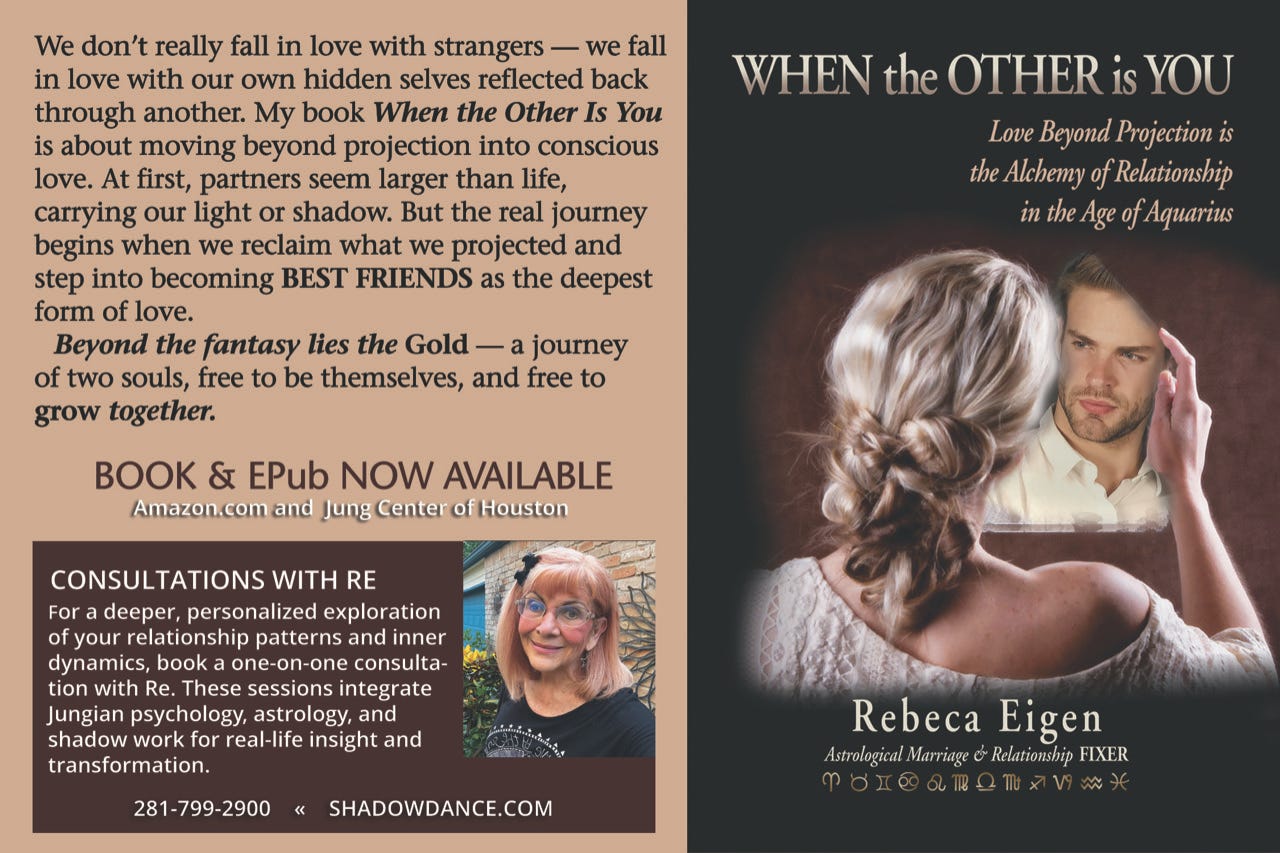
WHEN the OTHER is YOU is available on Amazon.com, my web site and the C.G. Jung Center Bookstore in Houston, Tx.
